Editor Team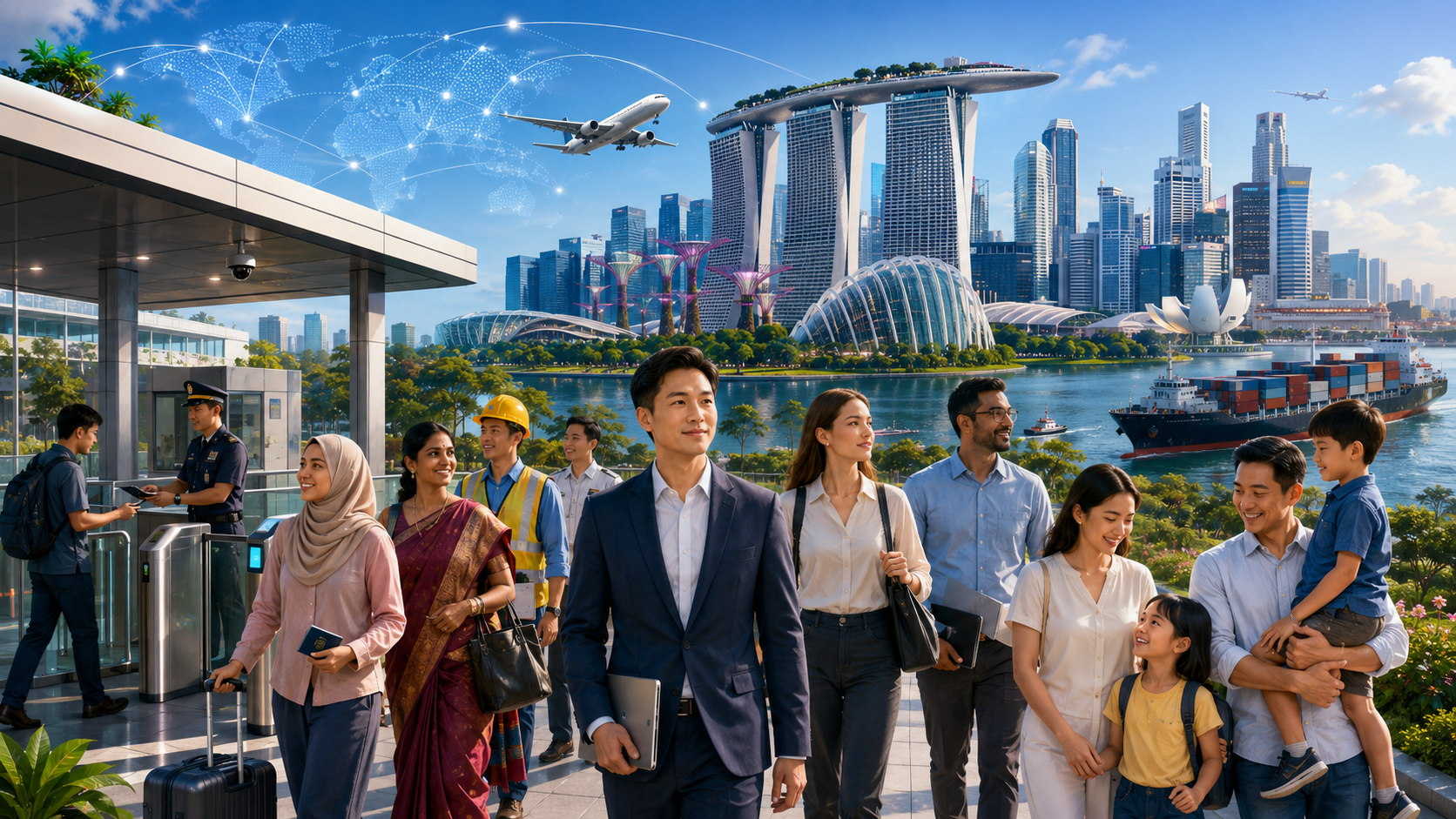
Singapore’s immigration policy is closely tied to its identity as a multicultural and globally connected country. The nation has long been shaped by migration, trade, and movement across borders. Today, immigration continues to influence Singapore’s economy, population structure, and social character. The government’s task is to keep the country open enough to attract talent and investment, while also ensuring that social harmony, national security, and local opportunities are not weakened.
The economic need for immigration is clear. Singapore has a small domestic population and a highly developed economy that requires many types of workers. Advanced industries need specialists in finance, artificial intelligence, cybersecurity, biomedical science, engineering, and education. At the same time, sectors such as construction, caregiving, hospitality, cleaning, and logistics rely on foreign workers to fill roles that are difficult to staff locally. Without foreign labour, many projects and services would become more expensive or slower to deliver.
To manage this need, Singapore uses a layered immigration system. Different passes apply to different groups of workers. Professionals are usually assessed through salary, qualifications, experience, and the value they bring to the economy. Mid-skilled and lower-skilled workers are subject to more restrictions, including quotas and levies. These measures help the government control the size and composition of the foreign workforce. They also encourage companies to raise productivity instead of depending too heavily on imported labour.
The policy is also designed to protect the local workforce. Singapore wants to remain attractive to global companies, but it cannot ignore citizens’ concerns about job security and wage competition. For this reason, employers are expected to follow fair hiring principles. The government has also strengthened efforts to ensure that companies do not discriminate against local applicants. Immigration policy therefore works alongside education, retraining, and lifelong learning programmes that help Singaporeans remain competitive.
Beyond economics, immigration has a social dimension. Singapore’s diversity is one of its strengths, but it requires careful management. The country has built a national culture around racial and religious harmony, respect for law, and shared public space. Newcomers are expected to understand these values. Integration is supported through schools, neighbourhoods, workplaces, and community networks. When immigrants participate in local life, they are more likely to form meaningful ties with Singaporeans rather than remain separate from society.
Permanent residency and citizenship are important tools in this process. Singapore grants them selectively because they carry long-term responsibilities. A person who becomes a permanent resident or citizen is not only gaining access to benefits but also becoming part of the country’s future. The state considers whether applicants can contribute economically, connect socially, and commit to Singapore. This selectivity helps manage population growth while strengthening national identity.
Security and enforcement are equally important. Singapore has strict immigration rules because illegal entry, overstaying, and false employment arrangements can damage confidence in the system. Strong border management and legal penalties send a clear message that openness must be matched by responsibility.
The Singaporean approach is not without tension. The country must continually balance business needs with citizen concerns, diversity with integration, and population growth with limited space. Its immigration policy shows how a small state can use careful planning to remain globally competitive while preserving social order and national unity.