Editor Team
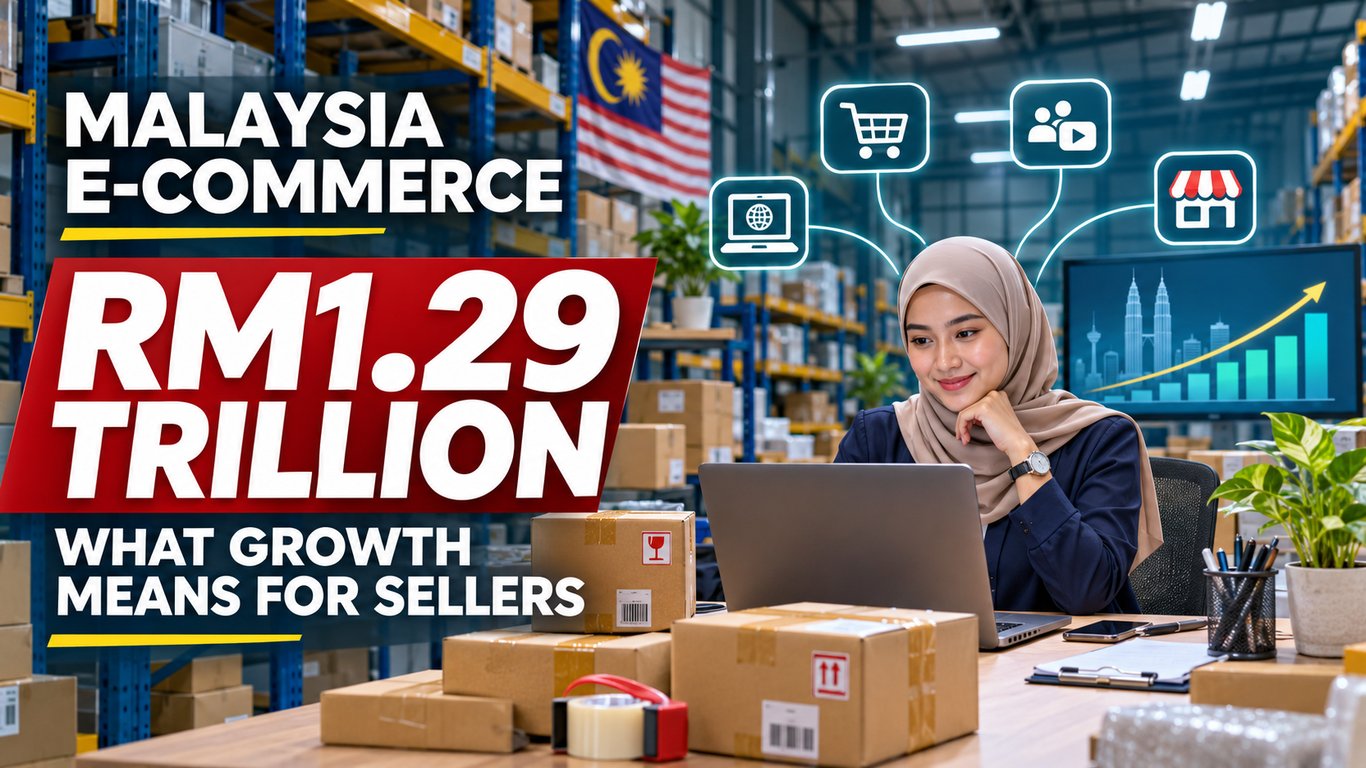
Malaysia’s e-commerce transaction income reached RM1.2881 trillion in 2024, an 8.8% increase from the previous year, according to the Department of Statistics Malaysia. Faster B2C and domestic-market growth, together with wider use of social media, websites and e-marketplaces, gives growing sellers a reason to review how orders, inventory and performance data connect across channels.
Malaysia’s e-commerce transaction income reached RM1,288.1 billion in 2024, increasing 8.8% from RM1,184.1 billion in 2023, according to statistics released by the Department of Statistics Malaysia on 30 June 2026.
The expansion continued into 2026. DOSM’s Quarterly Services Statistics for the second quarter of 2026 reported RM338.0 billion in e-commerce income, representing year-on-year growth of 2.9% and quarter-on-quarter growth of 1.0%.
These figures do not guarantee individual seller growth. They do show why businesses expanding across platforms, websites, social media and physical retail should check whether their operational data remains connected.
What the RM1.29 Trillion Figure Actually Measures
The RM1,288.1 billion figure represents income from e-commerce transactions recorded by Malaysian establishments across Agriculture, Mining and Quarrying, Manufacturing, Construction and Services. It should not be described as retail marketplace gross merchandise value or as the combined revenue of online marketplace sellers.
Services generated RM639.8 billion in e-commerce income in 2024, while Manufacturing contributed RM633.5 billion. Business-to-Business transactions remained the largest customer segment at RM879.6 billion, confirming that the national total extends well beyond consumer purchases on major marketplaces.
B2C and Domestic Transactions Grew Faster
DOSM’s Usage of ICT and E-Commerce by Establishment 2025 showed that Business-to-Consumer e-commerce income reached RM374.7 billion in 2024, up 11.3% from the previous year. B2B income increased 7.6%, while Business-to-Government income rose 11.4% to RM33.8 billion.
Domestic e-commerce transactions accounted for RM1,150.1 billion and grew 9.2%. International transactions reached RM138.0 billion, increasing 5.2%. These national results indicate continued expansion in domestic digital commerce, but they should not be treated as an individual seller growth forecast.
The Bigger Signal Is Multi-Channel Participation
The same DOSM release reported that 80.3% of businesses used social media, 58.7% had their own websites and 44.1% used e-marketplaces in 2024. These categories can overlap, meaning one business may maintain several digital sales and customer-engagement channels at the same time.
Consider a Malaysian retailer selling through Shopee, TikTok Shop, an independent website, social-media orders and a physical outlet. The same product may appear under different store SKUs and order flows. If each channel maintains separate inventory and fulfilment records, adding another sales channel can also add more stock checks, order handoffs and month-end reconciliation work.
What Growing Sellers Need to Connect
Channel growth should begin with consistent product and inventory references. Store SKUs need to map to the correct Merchant SKU and warehouse stock, while each order source requires a defined processing, picking, packing and shipping workflow.
Performance analysis also needs a consistent basis. Teams comparing marketplace, website, social and POS activity should understand which order date, payment date or confirmation date is used. Sales should be reviewed alongside cancellations, refunds, platform costs, advertising expenses, estimated profit and inventory movement rather than as an isolated headline number.
Connect Multi-Channel Operations with BigSeller
BigSeller allows sellers to connect supported stores and sales channels, including Shopee, Lazada, TikTok Shop, Shopify, WooCommerce and PGMALL. Supported platform, manual, POS retail and social-media orders can then enter defined order-processing workflows instead of being handled entirely through separate systems.
For management review, BigSeller’s Business Analysis Report supports Shopee, TikTok Shop, Lazada, POS retail orders, manual orders and BigShop. Its T+1 reporting covers dimensions including sales, cancellations, refunds, inventory and estimated profit at store or SKU level.
Connecting channels does not guarantee national-market growth or eliminate every operational error. Its purpose is to give growing teams a clearer process for maintaining products, inventory, orders and business data as the number of sales channels increases.
Growth Requires Connected Execution
Malaysia’s data reflects an expanding digital economy. For sellers, sustainable channel growth still depends on consistent product references, shared inventory rules, defined fulfilment workflows and comparable performance data.
This press release has also been published on VRITIMES