Editor Team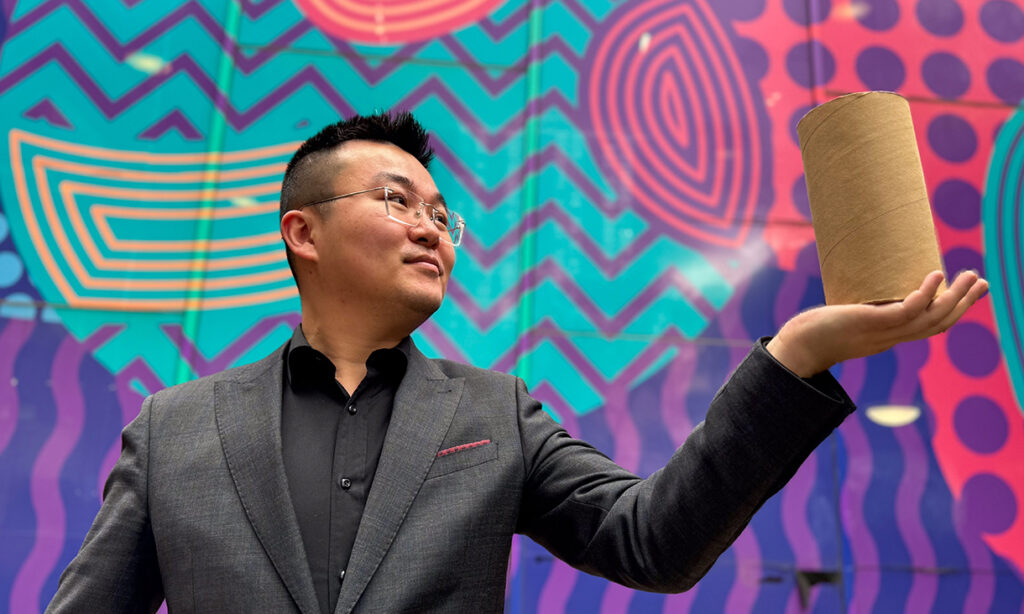
Engineers in Australia have developed a new building material with about one quarter of concrete’s carbon footprint, while reducing waste going to landfill.
This innovative material, called cardboard-confined rammed earth, is composed entirely of cardboard, water and soil – making it reusable and recyclable.
In Australia alone, more than 2.2 million tons of cardboard and paper are sent to landfill each year. Meanwhile, cement and concrete production account for about 8% of annual global emissions.
Cardboard has previously been used in temporary structures and disaster shelters, such as Shigeru Ban’s iconic Cardboard Cathedral in Christchurch, New Zealand.
Inspired by such designs, the RMIT University team has, for the first time, combined the durability of rammed earth with the versatility of cardboard.
Why it matters
Lead author Dr Jiaming Ma from RMIT said the development of cardboard-confined rammed earth marked a significant advancement toward a more sustainable construction industry.
“Modern rammed earth construction compacts soil with added cement for strength. Cement use is excessive given the natural thickness of rammed earth walls,” he said.
But cardboard-confined rammed earth, developed at RMIT University, eliminates the need for cement and boasts one quarter of the carbon footprint at under one third of the cost, compared to concrete.
“By simply using cardboard, soil and water, we can make walls robust enough to support low-rise buildings,” Ma said.
“This innovation could revolutionise building design and construction, using locally sourced materials that are easier to recycle.
“It also reflects the global revival of earth-based construction fuelled by net zero goals and interest in local sustainable materials.”
Practical benefits
The cardboard-confined rammed earth can be made on the construction site by compacting the soil and water mixture inside the cardboard formwork, either manually or with machines.
Study corresponding author and leading expert in the field of structural optimisation, Emeritus Professor Yi Min ‘Mike’ Xie, said this advancement can spearhead a leaner, greener approach to construction.
“Instead of hauling in tonnes of bricks, steel and concrete, builders would only need to bring lightweight cardboard, as nearly all material can be obtained on site,” Xie said.
“This would significantly cut transport costs, simplify logistics and reduce upfront material demands.”
Ma said cardboard-confined rammed earth could be an effective solution for construction in remote areas, such as regional Australia, where red soils – ideal for rammed earth construction – are plentiful.
“Rammed earth buildings are ideal in hot climates because their high thermal mass naturally regulates indoor temperatures and humidity, reducing the need for mechanical cooling and cutting carbon emissions,” he said.
The mechanical strength of the novel material varies based on the thickness of the cardboard tubes.
Ma said the team has developed the formula for this strength design.
“We’ve created a way to figure out how the thickness of the cardboard affects the strength of the rammed earth, allowing us to measure strength based on cardboard thickness,” Ma said.
In a separate study lead by Ma, carbon fibre was combined with rammed earth, proving it had a comparable strength to high-performance concrete.
Ma and the team are ready to partner with various industries to further develop this new material so it can be used widely. Companies looking to partner with RMIT researchers can contact research.partnerships@rmit.edu.au.
‘Cardboard-confined rammed earth towards sustainable construction’, with RMIT co-authors Jiaming Ma, Hongru Zhang, Vahid Shobeiri, Ngoc San Ha, Srikanth Venkatesan, Dilan Robert and Yi Min ‘Mike’ Xie, is published in Structures. (DOI: 10.1016/j.istruc.2025.110117)
‘CFRP-confined rammed earth towards high-performance earth construction’ is published in Composite Structures. (DOI: 10.1016/j.compstruct.2025.119512)