Editor Team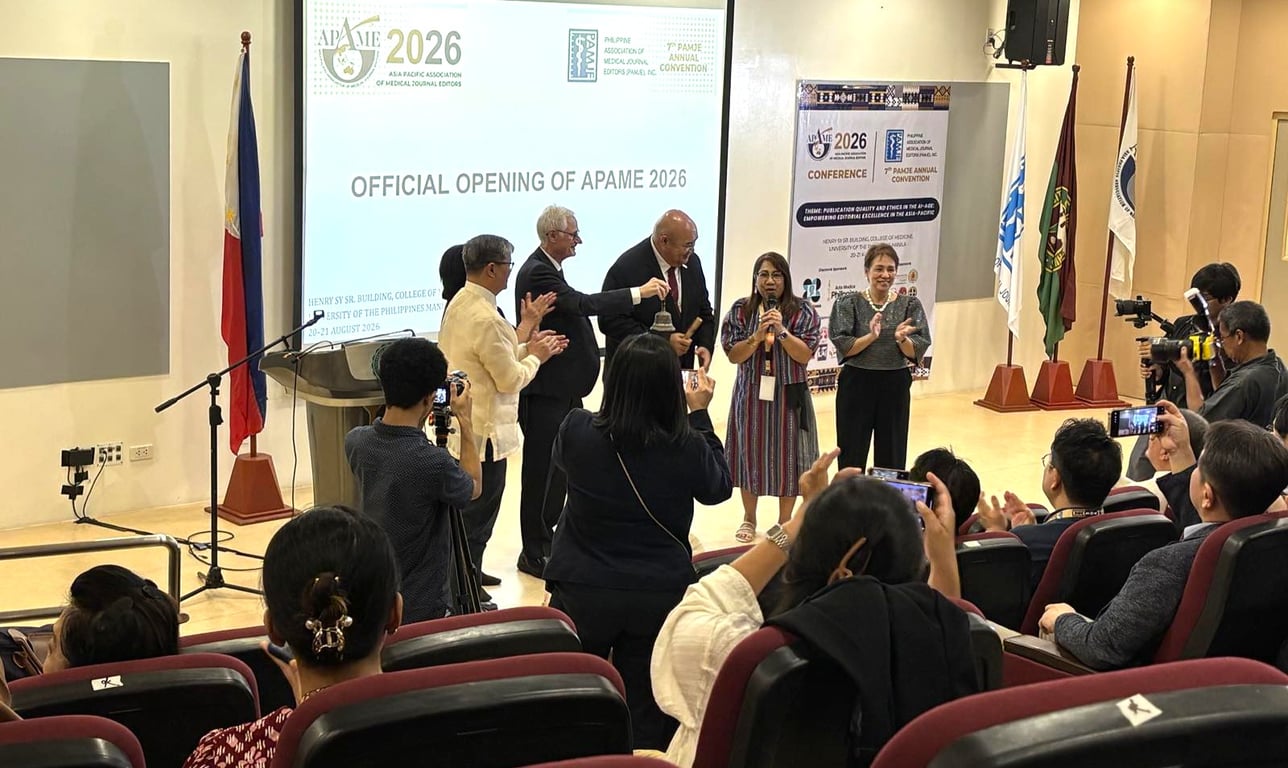
Top medical editors and researchers gathered in Manila to discuss how scholarly publishing can preserve trust in an increasingly AI-enabled research environment.
The Asia Pacific Association of Medical Editors (APAME) 2026 Conference and the 7th Philippine Association of Medical Journal Editors (PAMJE) Conference brought together medical editors, researchers, reviewers, publishers, librarians, and health professionals at the Henry Sy Sr. Building of the University of the Philippines Manila on August 20–21, 2026.
The well-attended conference featured prominent leaders in medicine, health research, medical publishing, and public policy from the Philippines and the Asia-Pacific region. Distinguished speakers included Dr. Saia Ma’u Piukala, Regional Director for the Western Pacific of the World Health Organization; Usec. Leah Buendia of the Department of Science and Technology; Prof. Michael Tee, Chancellor of the University of the Philippines Manila; PAMJE president Prof. Cecilia Maramba-Lazarte; UP Medicine Dean Prof. Charlotte Chiong; and Prof. Nicholas Talley of the Medical Journal of Australia.
The program also brought together experts from the World Association of Medical Editors, APAME, PAMJE, universities, medical journals, research institutions, libraries, and government agencies.
The conference marked the presentation of the first-ever APAME Presidential Awards, recognizing Dr. Jose Florencio Lapeña Jr., concurrently President of WAME, and Dr. Wilfred C. G. Peh for their contributions to editorial excellence, publication ethics, peer-review education, and the advancement of medical publishing in the Asia-Pacific region and beyond.
Discussions focused on research integrity, responsible artificial intelligence use, the declining pool of peer reviewers, and concerns about citation quality in published research.
AI brings promise and new risks
Artificial intelligence can support literature searching, language editing, translation, data analysis, coding, knowledge synthesis, and dissemination.
However, it may also amplify plagiarism, fabricated references, undisclosed generated content, inappropriate authorship, manipulated data or images, paper-mill activity, and other forms of misconduct.
The key issue is not simply whether AI should be used, but whether its use is appropriate, transparent, verifiable, and accompanied by clear human accountability.
AI tools cannot be authors because they cannot take responsibility for the accuracy, originality, confidentiality, or integrity of a publication. Human authors remain responsible for all content, including AI-assisted text, references, analyses, tables, code, images, and interpretations.
The future of peer review
Participants also discussed the declining and uneven availability of qualified peer reviewers worldwide.
Peer review provides independent scrutiny of a manuscript’s research question, methods, analysis, interpretation, originality, relevance, and ethical conduct. However, journals increasingly struggle to find reviewers with the appropriate expertise, no conflicts of interest, and sufficient time to complete careful assessments.
The growing complexity of manuscripts, and the need to evaluate AI-assisted content, data, images, and references, has added to this pressure.
The conference also raised concerns about citation quality. References may be incomplete, irrelevant, inaccurately described, or difficult to verify. AI tools have introduced an additional risk by generating citations that appear plausible but do not exist or do not support the claims for which they are cited.
101 Health Research facilitates two workshops
As part of the program, 101 Health Research contributed two workshops facilitated by its Founder and Managing Director, Dr. Venus Oliva Cloma-Rosales:
• Publication Quality and Ethics in the AI Age: How to Comply with the Latest Publication Guidelines
• Medical Statistics for Non-Statisticians
The first workshop presented publication compliance as a continuous process beginning with study planning and extending through data management, analysis, reporting, peer review, publication, and post-publication correction.
It examined the traditional dimensions of publication quality of substance, form, and style, and the growing importance of a fourth dimension: integrity.
Integrity encompasses authorship, accountability, transparency, data governance, confidentiality, responsible AI use, conflict-of-interest disclosure, accurate citation, reproducibility, and correction of errors.
Participants reviewed guidance from ICMJE, WAME, COPE, the EQUATOR Network, professional organizations, institutions, funders, and target journals. The session emphasized that responsible AI use requires human verification, protection of confidential information, careful checking of references, and documentation of significant decisions.
The second workshop focused on the SAMPL Guidelines, or the Statistical Analyses and Methods in the Published Literature guidelines. These support clear reporting of statistical methods and results, including the software used, estimates, measures of uncertainty, p-values, and the relationship between statistical findings and the research question.
The workshop reinforced that statistical reporting is not merely a technical requirement. Clear reporting allows readers, reviewers, and editors to understand how conclusions were reached and assess whether they are supported by the data.
Preserving trust in medical publishing
The APAME 2026 discussions reinforced that research integrity is a shared responsibility. Authors must report their work transparently, reviewers must provide independent and fair assessments, and editors must apply consistent standards and respond appropriately to ethical concerns.
Artificial intelligence may make research and publishing more efficient, but efficiency cannot replace judgment. The future of medical publishing will depend on stronger human systems for verification, peer review, accountability, and learning.
For 101 Health Research, preserving trust begins with sound methods, responsible statistics, transparent reporting, and integrity at every stage of the research and publication process.
Learn more about 101 Health Research’s work in research methods, biostatistics, publication support, and research integrity at 101healthresearch.com.