Editor Team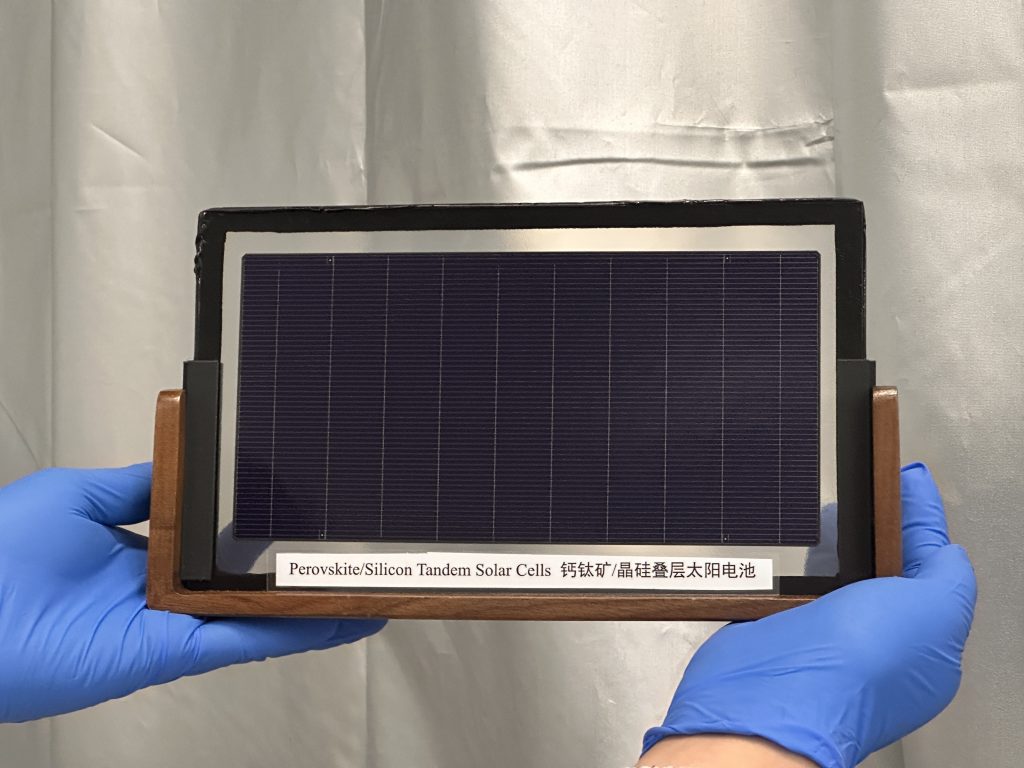
An international team of researchers has built the first high-performance, commercially sized tandem solar cell that doesn’t rely on the scarce and expensive metal, indium.
Published in Science, the breakthrough replaces indium-based oxide with abundant tin oxide, a material that costs one per cent as much, without sacrificing performance.
The advance brings next-generation tandem solar cells a step closer to commercial production, offering the potential for cheaper solar panels that generate more electricity from the same amount of sunlight.
Professor Yuan Cheng from Monash Suzhou and the Department of Materials Science and Engineering at Monash said the milestone marks the first realisation of a large-area, highly efficient indium-free perovskite tandem solar cell, showing that the technology can be scaled beyond laboratory-sized devices.
“Considering the cost of tin is a mere one per cent of that of indium, this breakthrough unveils a new material paradigm and a highly viable engineering route for low-cost, sustainable, and scalable tandem photovoltaics,” Professor Cheng said.
“Ultimately, this work is of paramount strategic importance for propelling the industrialisation and terawatt-scale deployment of next-generation ultra-high-efficiency photovoltaic technologies.”
As demand for solar energy continues to grow worldwide, reducing reliance on scarce materials is becoming increasingly important. Indium is used in a wide range of electronics, and its limited supply presents challenges for large-scale manufacturing.
By replacing indium with tin oxide using a low-damage reactive plasma deposition process, the researchers created solar cells that achieved a certified efficiency of 31 per cent in a commercially sized mini-module while also improving durability.
The devices also withstood heat, humidity and more than three months of outdoor operation while maintaining strong performance.
Professor Cheng said achieving more than 30 per cent efficiency in a commercially sized tandem module is a major technical milestone, and demonstrates that high performance can be maintained without relying on scarce, high-cost materials.
“The research team developed a reactive plasma deposition (RPD) process for tin oxide (SnOx) films to serve as the recombination layer, achieving a remarkable certified efficiency of 33.6 per cent on 1 cm2,” Professor Cheng said.
“By further extending the application of RPD-SnOx to both the front and rear transparent electrodes, we successfully fabricated indium-free tandem solar cells. Remarkably, we scaled this technology up to a 207.9 cm2 mini-module, obtaining an outstanding certified efficiency of 31.0 per cent.”
The research was lead by a collaborative team including Professor Yuan Cheng (Monash University),Professors Xiaohong Zhang and Xinbo Yang (Soochow University), Dr Zijia Li (Chint New Energy Technology Co. Ltd), with multiple renowned universities and leading enterprises in the photovoltaic industry.
Read the research paper: https://www.science.org/doi/10.1126/science.aef5355
This press release has also been published on VRITIMES