vritimes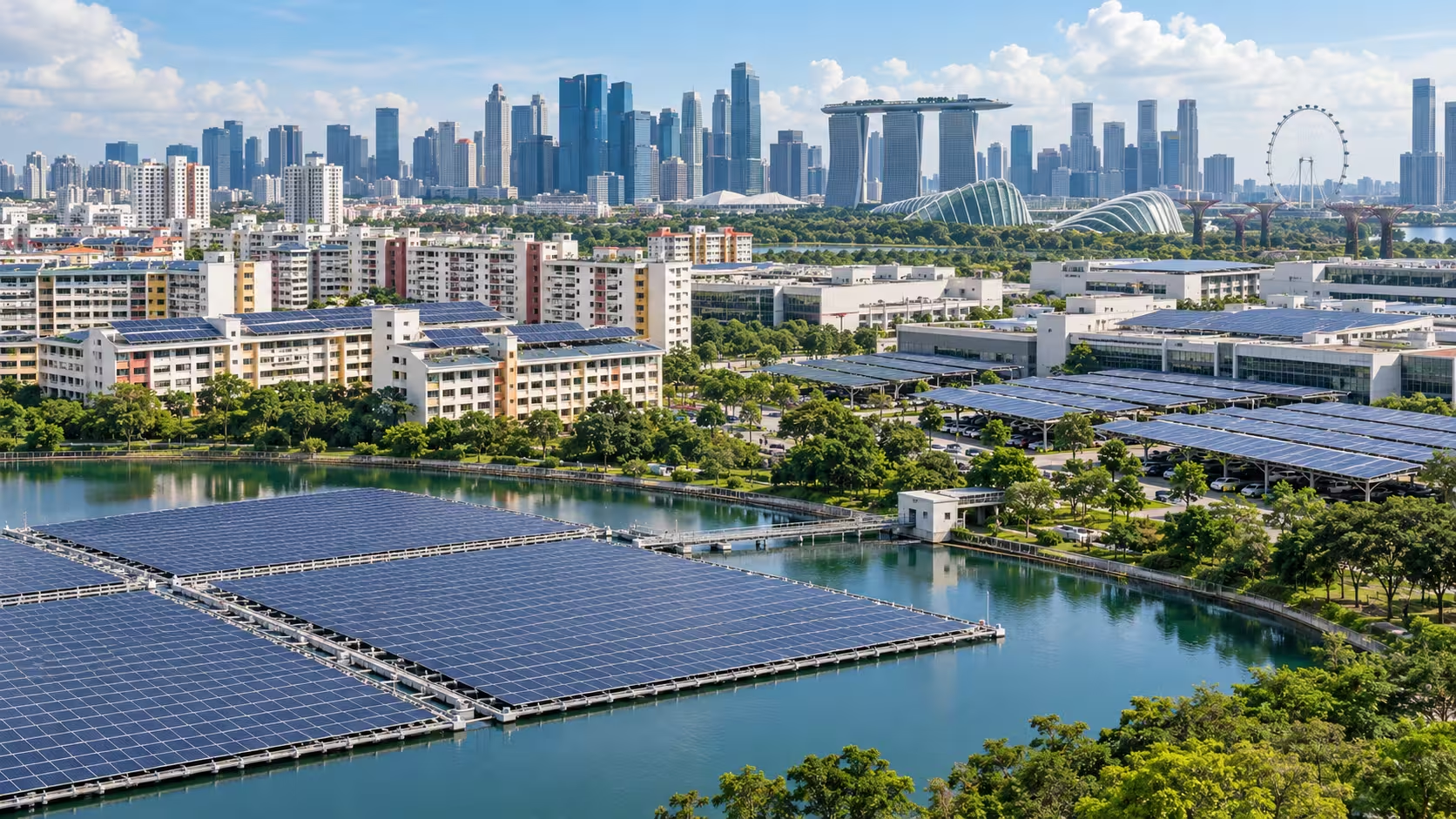
When Marine Biology Becomes an Engineering Crisis
Singapore’s offshore floating solar farm in the Strait of Johor was supposed to solve a simple problem: too little land, too much sun. Completed in 2021 by Sunseap (now EDP APAC), the 5 MWp installation deploys 13,312 photovoltaic panels across more than 30,000 floating pontoons, spanning roughly five hectares of coastal waters.
The engineering challenge was obvious from the start: waves, currents, saltwater corrosion. What engineers didn’t fully anticipate was barnacles.
43% Mass Increase: The Silent Threat
By 2026, marine organisms—primarily barnacles—had attached themselves to the floating infrastructure, increasing total floater mass by nearly 43%. This surging weight places severe strain on pontoon buoyancy and puts critical electrical connectors at immediate risk. In tropical waters, biofouling is not a minor maintenance issue; it is a structural threat.
Engineering for a Living Ocean
The Woodlands project was never a conventional solar farm. The platform is constantly exposed to movement from waves, currents, wind, and passing vessels. Engineers designed a compliant floating system that moves with the water, held in position by a constant-tension mooring system. Corrosion from prolonged saltwater exposure was factored in from the beginning.
But barnacles add a biological dimension that no corrosion model predicts. The additional mass changes buoyancy calculations. The organisms can block cooling pathways and accelerate wear on connectors. Maintenance crews must now factor in dive teams and biofouling removal alongside electrical inspections.
Why Singapore Built on the Sea
Singapore has no choice but to innovate. Dense urban development leaves limited room for conventional ground-mounted solar farms. Rooftops provide part of the solution, but not all of it. The Strait of Johor offered a surface that doesn’t compete with housing, industry, or transport.
The project’s peak capacity is 5 MWp, with estimated annual production of about six million kilowatt-hours—enough for roughly 1,250 four-room flats.
Key data point: Marine growth has increased floater mass by nearly 43% since deployment, threatening buoyancy and electrical connectors. Source: Economic Times 2026 report.
Singapore’s offshore solar experiment is a global test case. If biofouling can be managed economically, floating solar becomes viable for coastal cities worldwide. If not, the barnacles may have delivered a costly lesson in tropical marine engineering.


 Editor Team