Editor Team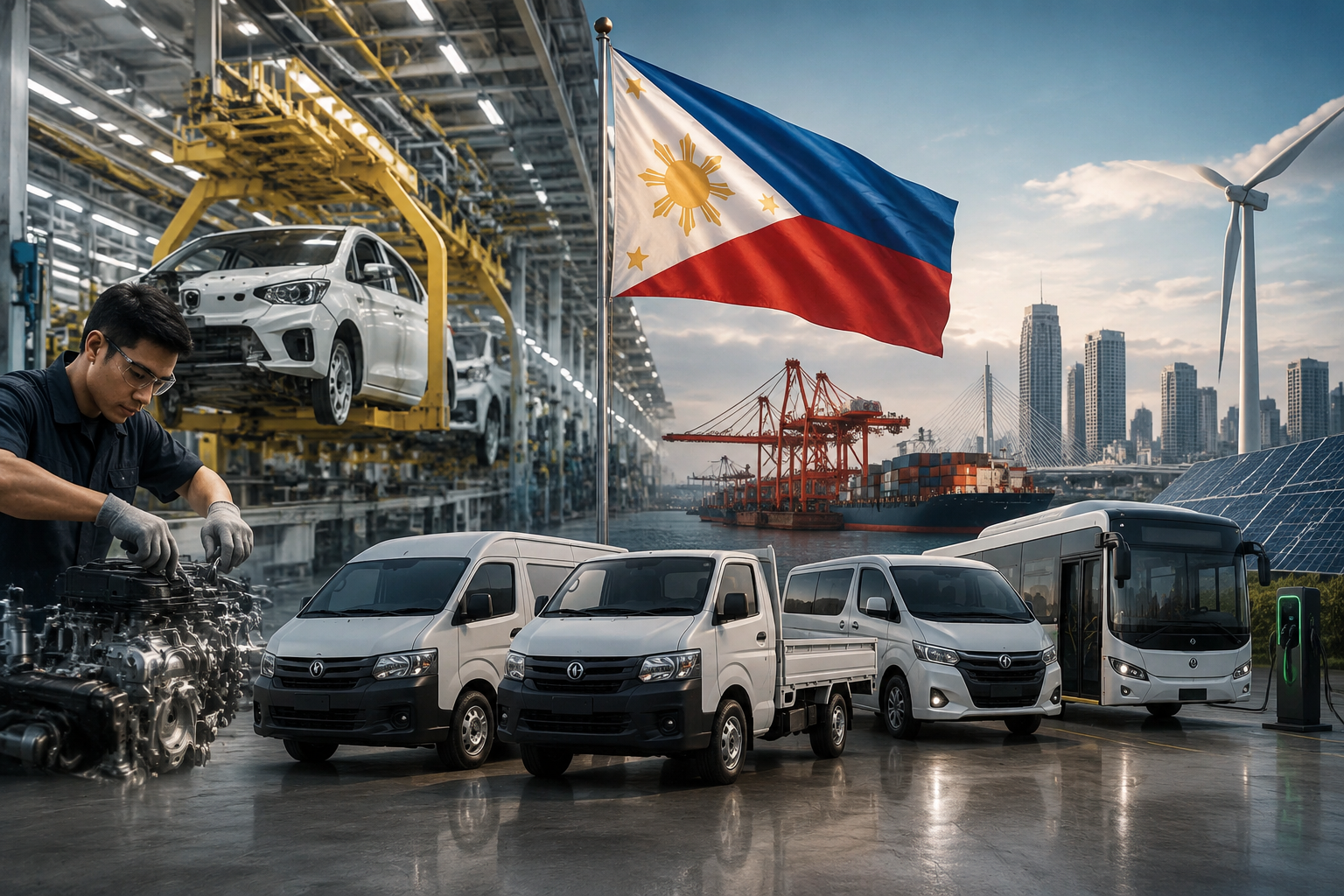
The Philippine automotive industry is entering a new development phase as manufacturers, policymakers, and local suppliers reconsider the strategic value of domestic vehicle production. Although the country remains heavily dependent on imported vehicles, recent investments in locally assembled passenger cars, commercial vehicles, and electrified models indicate that manufacturing still has an important role in the national economy.
For many years, Philippine vehicle assembly struggled against larger production centers in Thailand and Indonesia. These neighboring countries developed deeper supplier networks, higher production volumes, and stronger export capabilities. Philippine factories, by comparison, often faced higher component costs and a smaller domestic production base.
The government attempted to address these disadvantages through the Comprehensive Automotive Resurgence Strategy, or CARS, Program. Information from the Philippine Board of Investments explains how industrial incentives are intended to encourage vehicle manufacturers to invest in local assembly, parts production, tooling, and workforce development.
Toyota Motor Philippines and Mitsubishi Motors Philippines became the program’s major participants through local production of the Toyota Vios and Mitsubishi Mirage. These projects helped preserve manufacturing jobs and supported domestic suppliers producing components such as stamped metal parts, plastic assemblies, wiring systems, and automotive seats.
The Toyota Tamaraw Illustrates a More Practical Strategy
One of the most relevant recent examples is the return of the Toyota Tamaraw as a locally assembled utility vehicle. Rather than competing only in the crowded passenger-car market, the model addresses demand from small businesses, logistics operators, local governments, agricultural enterprises, and public transport providers.
The Tamaraw can be configured as a delivery van, passenger shuttle, refrigerated vehicle, ambulance, or mobile store. This flexibility highlights a potential competitive advantage for Philippine manufacturing: producing vehicles that can be adapted to local commercial requirements.
Utility vehicles also create opportunities for body builders, equipment installers, and small component manufacturers. Their economic impact can therefore extend beyond the assembly plant itself.
Why Local Assembly Still Faces Structural Pressure
Domestic production remains more expensive when factories operate below optimal scale. Manufacturers must spread investments in machinery, engineering, testing, and quality control across a relatively limited number of vehicles.
Tariff-free or lower-tariff imports from ASEAN production hubs also place pressure on locally assembled models. Imported crossovers, pickups, and multipurpose vehicles frequently benefit from larger regional factories and mature supplier ecosystems.
For local manufacturing to remain viable, the Philippines must improve port efficiency, power reliability, technical training, industrial logistics, and access to competitively priced components. Incentives alone cannot compensate for weaknesses across the wider production environment.
Local Content Will Determine the Real Economic Value
A vehicle may carry a “made in the Philippines” label while still using a large percentage of imported components. The deeper economic benefit appears when domestic companies supply more advanced parts, engineering services, software, electronics, and production equipment.
The Philippines already has considerable experience in electronics and semiconductor manufacturing. Connecting that expertise with automotive production could support future demand for sensors, battery-management systems, power electronics, charging equipment, and connected-vehicle technologies.
The Next Manufacturing Cycle Will Be More Specialized
The future of Philippine automotive production is unlikely to depend on copying the mass-production model of Thailand. A more realistic strategy would emphasize commercial vehicles, flexible utility platforms, electric public transport, motorcycles, automotive electronics, and selected components for regional export.
Local assembly will remain relevant when it solves specific transport and business problems. The strongest manufacturers will be those that combine production scale with customization, energy efficiency, reliable after-sales service, and a supply chain capable of supporting both conventional and electrified vehicles.