vritimes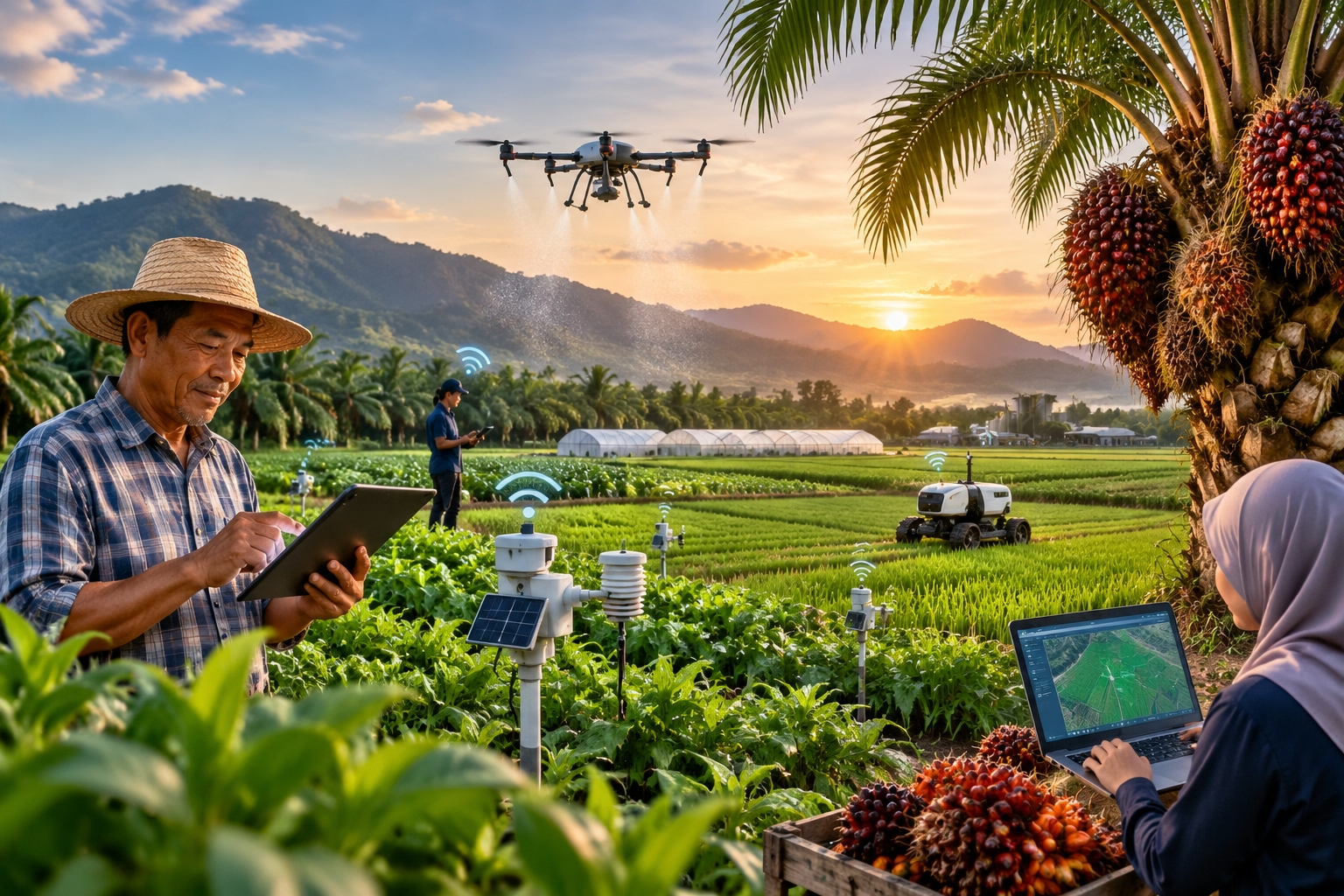
The Policy Push Behind Malaysia’s Digital Agricultural Transformation
Malaysia’s agricultural sector is undergoing a fundamental transformation driven by an urgent need to strengthen food security and reduce reliance on imports. Agriculture contributes approximately 8% to the national GDP and supports over 1.5 million livelihoods, yet the sector faces persistent structural challenges including ageing farmers, fragmented value chains, and uneven productivity gains. The government has responded with ambitious policy frameworks, most notably the Dasar Agromakanan Negara 2.0 (DAN 2.0), which articulates a long-term vision for transforming agriculture through technology adoption and innovation.
Under the 13th Malaysia Plan (2026-2030), the Ministry of Agriculture and Food Security (KPKM) received RM6.87 billion (USD 1.76 billion) for 2026, representing a seven percent increase from the previous year’s allocation. This substantial funding increase signals the government’s recognition that agricultural modernisation cannot proceed without strategic investment in digital infrastructure, research, and farmer education.
Frontier Technologies Reshaping Malaysian Farms
A landmark briefing paper published by the World Economic Forum in July 2026 identified several frontier technologies that hold particular promise for Malaysia’s agricultural sector. These include artificial intelligence (AI) for precision farming, Internet of Things (IoT) sensors for real-time crop monitoring, and blockchain systems for supply chain traceability. The report noted that initiatives under MAFS and the Malaysia Digital Economy Corporation (MDEC) have facilitated the adoption of Fourth Industrial Revolution technologies across the agricultural value chain.
The real-world impact of these technologies is becoming increasingly visible. In Kedah, the Digital AgTech programme has deployed IoT and AI-enabled farming systems across 15 projects with an estimated value exceeding RM300,000, targeting smallholder farmers who have historically been excluded from technological advancement. These systems enable farmers to monitor soil conditions, optimise irrigation schedules, and predict pest outbreaks with unprecedented accuracy.
The Smallholder Adoption Gap: Challenges and Solutions
Despite these promising developments, technology adoption among smallholder farmers remains uneven. Research indicates that only 27% of Malaysian smallholder farmers currently integrate IoT solutions, with upfront costs, inadequate digital infrastructure, and insufficient technical training cited as primary barriers. Furthermore, adoption of AI-enabled farming tools in pilot zones such as Melaka has been reported at critically low levels, with only about 12% usage among targeted farmers.
Addressing this adoption gap requires a multi-pronged approach. The Malaysia Digital Economy Corporation has advocated for affordable shared-access models, continuous farmer training programmes, and improved rural digital infrastructure as essential enablers for widespread technology diffusion. Public-private partnerships have also emerged as an effective mechanism for driving innovation, with stakeholders such as technology providers, financial institutions, and agricultural cooperatives collaborating to reduce barriers to entry.
Real-World Impact: Lessons from the Field
The transformation is already yielding tangible results in specific agricultural sub-sectors. In the palm oil industry, the Malaysian Palm Oil Board (MPOB) launched nine new technologies in June 2026, including SawitSCAN, an AI-powered system capable of automatically identifying the ripeness of fresh fruit bunches with greater accuracy and speed than manual inspection. These innovations demonstrate how technology can simultaneously enhance productivity, reduce labour dependency, and improve quality consistency.
The World Economic Forum briefing paper emphasised that Malaysia’s agricultural transformation must balance three interconnected priorities: food security and self-sufficiency, economic competitiveness and value creation, and sustainability and climate resilience. Technology serves as the common thread linking these objectives, enabling farmers to produce more with fewer resources while reducing environmental impact.


 Editor Team